
On 1 April 2026, the Belgian Chinese Chamber of Commerce (BCECC) and the China Council for the Promotion of International Trade (CCPIT) Representative Office in the EU, jointly organized in Brussels an event focusing on China Belgium clean energy business exchange. Held at a time when the global energy system is undergoing profound transformation, the event brought together Chinese and Belgian enterprises, policymakers and experts to exchange insights on clean energy development and explore concrete opportunities for bilateral cooperation. The exchange took place against a backdrop of accelerating global efforts to transition towards green and low carbon development. Clean energy has become not only a cornerstone of climate policy, but also a strategic driver of industrial competitiveness, technological leadership and energy security. For both China and Belgium, strengthening cooperation in this field is increasingly seen as both an economic opportunity and a strategic necessity.
Complementary strengths for cooperation
In his opening remarks, Bernard Dewit, Chairman of the Belgian-Chinese Chamber of Commerce, underlined that green energy and business relations around this theme are becoming increasingly central in China-Belgium cooperation. Belgium has unique strengths across several domains, including port logistics, energy infrastructure and technological innovation. China, on the other hand, possesses strong capabilities in new energy equipment manufacturing and highly developed supply chain systems. In a global context marked by energy transition, climate challenges and geopolitical uncertainty, platforms that promote dialogue, partnerships and innovation are more important than ever.
China’s energy transition: From emissions peak to global leadership
China’s energy transformation is occurring at an unprecedented scale and speed. Long regarded as the world’s largest emitter of greenhouse gases, China has reached a critical turning point. Coal consumption has begun to stabilize, and there are strong indications that carbon emissions have peaked structurally rather than a temporary consequence of economic slowdown. This shift is the result of a deliberate and centrally coordinated strategy.
Each year, China installs more renewable energy capacity than the rest of the world combined. Today, it accounts for nearly two-thirds of newly added global wind and solar capacity. Massive investments in wind power, solar photovoltaics, battery storage, electric vehicles, grid infrastructure and industrial electrification are reshaping the country’s energy system. At the same time, China is systematically electrifying major parts of its economy – from transport and heavy industry to building heating – while progressively greening the electricity supply itself.
This dual approach, combining rapid electrification with clean power generation, creates a powerful cumulative effect. As fossil fuel based applications are replaced by electric alternatives and electricity becomes cleaner, emissions begin to decline more rapidly. Beyond reducing emissions, this strategy also enhances energy security by reducing dependence on imported oil and gas.
Clean energy as an industrial strategy
China’s clean energy transition is closely linked to industrial development. By making electric vehicles, batteries, solar panels, wind turbines and related technologies globally competitive, China has created entire new industrial ecosystems. It now dominates large parts of the global clean energy supply chain, including manufacturing capacities and critical raw materials processing. This dominance brings efficiency and scale advantages, but raises legitimate questions globally about diversification, resilience and long-term connections across global supply chains.
This leadership has also enabled China to export clean energy technologies worldwide, positioning the country as a key enabler of the global energy transition. It has also raised concerns in other regions about overcapacity, supply chain concentration and industrial competitiveness – issues that were also reflected upon during the business exchange in Brussels. These dynamics underscore the importance of dialogue and cooperation to ensure fair competition, resilient supply chains and mutual economic benefit.
Belgium’s strengths in clean energy and international cooperation
Belgium, despite its small geographical size, plays a significant role in Europe’s clean energy transition. The country has become a global leader in offshore wind power, ranking among the top countries worldwide in installed capacity. Further expansion is expected as Belgium works closely with neighboring North Sea countries to develop a combined offshore electricity grid.
In addition to renewable electricity generation, Belgium has demonstrated a strong commitment to cross-border energy cooperation. Partnerships with the Netherlands, Germany and France have reinforced security of gas supply and regional energy resilience. At the same time, Belgium is experiencing a rapid uptake of electric vehicles and continues to invest in modernizing its energy infrastructure.
Challenges remain, particularly in reducing greenhouse gas emissions more rapidly and addressing the high energy costs faced by Belgian industry. Energy-intensive sectors play a crucial role in the Belgian economy, especially in Flanders, and require long-term policy certainty to invest in decarbonization while maintaining international competitiveness.
Opportunities for China–Belgium cooperation
The event highlighted how the complementary strengths of both countries can form the basis for deeper cooperation. China brings scale, manufacturing capacity and rapidly advancing technologies. Belgium contributes advanced engineering know-how, offshore expertise, regulatory experience within the EU and a strong tradition of international collaboration.
Potential areas for cooperation include renewable energy technologies, energy storage, hydrogen applications, smart grids and industrial decarbonization solutions. As Europe introduces new policy tools such as carbon pricing mechanisms and border adjustment measures to support climate goals and fair competition, dialogue with Chinese partners becomes even more important.
In addition to renewable electricity generation, Belgium has demonstrated a strong commitment to cross-border energy cooperation. Partnerships with the Netherlands, Germany and France have reinforced security of gas supply and regional energy resilience. At the same time, Belgium is experiencing a rapid uptake of electric vehicles and continues to invest in modernizing its energy infrastructure.
Challenges remain, particularly in reducing greenhouse gas emissions more rapidly and addressing the high energy costs faced by Belgian industry. Energy-intensive sectors play a crucial role in the Belgian economy, especially in Flanders, and require long-term policy certainty to invest in decarbonization while maintaining international competitiveness.
Opportunities for China–Belgium cooperation
The event highlighted how the complementary strengths of both countries can form the basis for deeper cooperation. China brings scale, manufacturing capacity and rapidly advancing technologies. Belgium contributes advanced engineering know-how, offshore expertise, regulatory experience within the EU and a strong tradition of international collaboration.
Potential areas for cooperation include renewable energy technologies, energy storage, hydrogen applications, smart grids and industrial decarbonization solutions. As Europe introduces new policy tools such as carbon pricing mechanisms and border adjustment measures to support climate goals and fair competition, dialogue with Chinese partners becomes even more important.
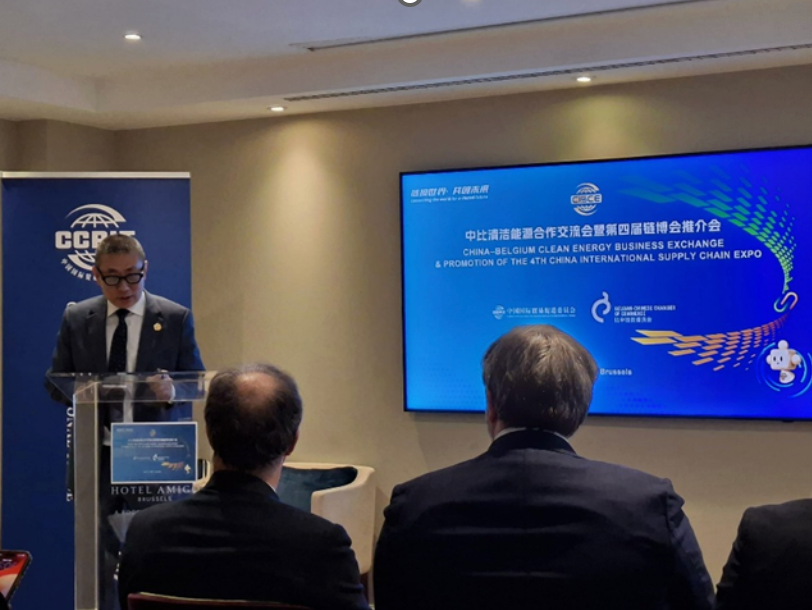
The event also featured a presentation on the 4th China International Supply Chain Expo (CISCE), underscoring the growing importance of supply chains as a platform for cooperation rather than fragmentation. In a world market marked by geopolitical uncertainty and economic volatility, resilient and sustainable supply chains are increasingly central to the energy transition.
Looking Ahead
The transition to a green, low carbon economy is one of the defining challenges and opportunities of our time. China’s large scale energy transformation and Belgium’s leadership in offshore wind and international energy cooperation illustrate two different yet complementary pathways toward a shared goal. The event in Brussels provided a timely platform to connect these pathways, foster mutual understanding, and identify concrete cooperation opportunities.
The Belgian-Chinese Chamber of Commerce (BCECC) will continue to follow developments in China and support Belgian and Chinese companies in strengthening their business cooperation.