
One of China’s most distinctive economic features is its reliance on long-term strategic visions. These are not marketing slogans or propaganda, but detailed frameworks that align government priorities, industrial investment, and research over a decade or more. These government policies dictate where talent is trained, which infrastructure is built, and how subsidies flow. Understanding China’s long-term industrial strategies is essential for Belgian companies looking to grow, innovate and partner in this dynamic market.
In 2015, Beijing announced Made in China 2025 (MIC2025), an ambitious strategy to upgrade the country’s manufacturing base and position China at the forefront of high-tech industries. Made in China 2025 is an initiative aimed at transforming China into a global manufacturing superpower by 2049. It seeks to localize production, reduce dependence on foreign companies and increase the competitiveness of domestic companies. It focused on areas such as robotics, aerospace, advanced rail systems, new energy vehicles and next-generation information technology. The plan raised concern in Europe and beyond, as it signaled China’s determination to compete with established industrial powers.
A central pillar was technological self-reliance, developing domestic capabilities for core technologies such as semiconductors and precision tools. This approach combined state support, innovation incentives, and substantial support for strategic domestic companies. The plan drew global attention as a signal that China intended to compete in areas long dominated by others.
New Quality Productive Forces – since 2023
A decade later, the official slogan has evolved. The current policy priority is New Quality Productive Forces (新质生产力), a concept introduced by President Xi Jinping in 2023. While the phrase may sound abstract, its implications are concrete. Unlike the fixed 10-year Made in China 2025 program, New Quality Productive Forces functions as a broad guiding framework for policy. It aims to integrate advanced technologies (AI, quantum computing, advanced materials, biotechnology, green energy) across the economy.
Where Made in China 2025 emphasized upgrading capacity, New Quality Productive Forces stresses quality, efficiency, and integration of hardware, software, and services. It reflects a shift from scale-driven to innovation-driven growth, with adaptability at its core. It emphasizes innovation-driven, green, and digital productivity – areas where Belgian companies have both strengths and vulnerabilities.
From pure manufacturing to quality and innovation
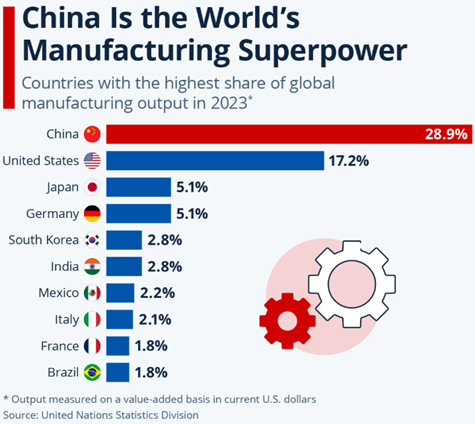
China has already become the world’s largest manufacturer by scale, but New Quality Productive Forces shift the focus from pure output to high-value innovation. The goal is to foster advanced technologies, sustainable production, and globally competitive industries that are less reliant on foreign know-how. For Belgian companies, this means the Chinese market is no longer simply a destination for selling goods, but also a highly dynamic competitor and partner in advanced sectors.
Strategic sectors aligned with Europe
Many of the sectors prioritized under this new framework overlap with Europe’s industrial strengths: renewable energy, advanced manufacturing, electric vehicles, semiconductors, biotechnology, and digital platforms. This overlap creates opportunities for collaboration in research, joint ventures and investment. At the same time, it also introduces new risks of being overtaken if Belgian companies fail to keep pace with China’s fast-moving innovation and state-supported growth.
Why It matters for Belgian companies
• Market opportunities: China remains the world’s second-largest economy with an expanding middle class. Demand for sustainable, high-quality products and services is growing, offering Belgian companies room to position themselves as premium partners.
• Innovation partnerships: Chinese companies are investing heavily in R&D, especially in green tech and digital solutions. Collaborations with local companies, universities, and research parks can help Belgian companies tap into this innovation ecosystem.
• Competitive pressure: The shift toward “quality” means Belgian companies will face Chinese competitors not only on cost, but increasingly on technology and brand. Preparing for this new competition is essential for maintaining market share.
• Regulatory and policy impact: The concept of New Quality Productive Forces is being integrated into China’s five-year plans and local development policies. Understanding these frameworks helps Belgian businesses anticipate regulatory changes, subsidies and procurement trends.

Both Made in China 2025 and New Quality Productive Forces show how China coordinates national development through sustained priorities by outlining strategies that align policy choices, investment decisions and innovation efforts. Even when targets evolve, the sectors identified tend to enjoy long-term policy support, funding, and favourable regulation. This ensures long-term continuity, enabling large-scale development instead of short-term and fragmented policymaking.
For Belgian companies, these plans help identify where growth, partnerships and competition will intensify. For policymakers, they indicate the fields where China is most determined to lead.
A Call for strategic engagement
For Belgian companies, the key lesson from the transition from Made in China 2025 to New Quality Productive Forces is clear: China is not standing still. It is rapidly climbing the value chain and redefining global industrial standards. Ignoring this shift risks missing out on vital opportunities and being surpassed by new competitors.
Considering all the information above, engagement should therefore be proactive, strategic and selective. By investing in partnerships, protecting intellectual property and aligning with China’s sustainability and innovation goals, Belgian companies can position themselves as indispensable players in this next phase of China’s economic evolution. Ultimately, this approach ensures that Belgian companies can navigate China’s complex market while contributing to long-term, mutually beneficial growth.
Please contact us in case you need more information.